Experience should be one of the first things you consider when choosing a hardwood flooring professional. Installing wood flooring requires more than placing boards across a room. An experienced installer knows how to measure accurately, prepare the subfloor, create expansion gaps, align boards, and work around doors, stairs, cabinets, and other obstacles.
Ask how long the installer has worked with hardwood and what types of projects they regularly complete. Someone who handles solid hardwood, engineered wood, and specialty flooring is more likely to understand different installation methods.
Experience also helps professionals identify problems before they become expensive. Uneven subfloors, moisture concerns, damaged areas, and poor preparation can affect the finished floor. Ask for examples of previous work or photos of completed projects.
A strong track record does not mean you must hire the most expensive contractor. Look for relevant experience, consistent workmanship, and an understanding of your specific flooring needs.
Before hiring an installer, verify that the company operates professionally and carries appropriate insurance. Flooring work takes place inside your home, so you want a contractor who takes responsibility for protecting your property and completing the project properly.
Ask whether the installer carries general liability coverage and, when applicable, workers’ compensation insurance. These protections can reduce your financial risk if property damage or an on-site injury occurs.
You should also ask about licenses, registrations, or professional credentials that may apply in your area. Requirements vary by location and the type of work being performed. A reputable flooring company should be comfortable explaining its qualifications.
Good communication from the beginning often makes the entire installation easier to manage. Pay attention to response times, written estimates, appointment reliability, and how clearly the company explains project details before work starts.
A quality hardwood floor installation should begin with preparation rather than immediately laying boards. The installer should inspect the existing floor and determine whether the subfloor is clean, stable, level, dry, and suitable for the selected flooring.
Subfloor preparation is important because hardwood can reveal imperfections underneath it. If the surface is uneven or unstable, the finished floor may develop movement, squeaks, or visible inconsistencies. Ask whether repairs, leveling, or moisture testing are necessary.
The installer should also discuss board direction, room layout, transitions, and the placement of cuts. Depending on the flooring product, wood may need time to adjust to indoor temperature and humidity before installation.
Ask which installation method will be used and why it suits your flooring. Nail-down, staple-down, glue-down, and floating methods each have specific applications. A knowledgeable installer should explain the process clearly.
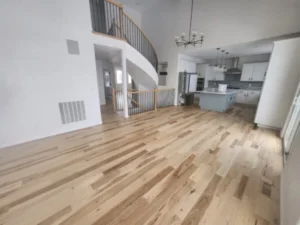
A careful hardwood floor installation should leave clean edges, consistent spacing, secure boards, and smooth transitions between rooms. Ask the installer to review these details with you during the final inspection before the project is considered complete.
The installer should be able to explain which flooring materials are appropriate for your home. Wood flooring comes in many species, grades, widths, finishes, and construction types, and each option can perform differently.
Solid hardwood is made from a single piece of wood and can often be refinished several times. Engineered wood contains multiple layers and can offer greater dimensional stability in some environments. Neither option is automatically best for every room, so recommendations should reflect your home’s conditions and your expectations.
Ask what brands and products the installer typically uses and request product information before making a decision. You should also understand the manufacturer’s warranty requirements because improper installation may affect coverage.
Consider durability as well as appearance. A beautiful flooring option may not be ideal for a busy household or a room exposed to changing humidity. A good installer should explain advantages and limitations without pressuring you into the most expensive product.
Price matters, but the lowest estimate is not always the best value. When comparing a wood floor installation service, request detailed written estimates from qualified companies so you can see what each proposal includes.
A complete estimate should identify flooring materials, labor, preparation, removal of existing flooring when needed, trim, transitions, disposal, and other expected charges. If some costs depend on the condition of the subfloor, the installer should explain that before work begins.
Be cautious when one quote is much lower than the others without a clear reason. The difference may come from cheaper materials, limited preparation, or services being left out of the proposal.
Ask about payment terms, deposits, scheduling, and possible changes to the final price. Written details reduce misunderstandings and give you a clear record of what was agreed upon.
Compare estimates carefully, not price alone. Quality workmanship and proper preparation can save money by preventing repairs later.
Online reviews can provide useful insight into what it is like to work with a flooring installer. Look for patterns instead of relying on one unusually positive or negative review.
Pay attention to comments about communication, punctuality, cleanliness, workmanship, and how the company handled unexpected problems. Reviews that mention hardwood projects may be especially useful because they provide evidence of experience with work similar to yours.
Ask whether the contractor can show previous projects or provide references when appropriate. Photos can help you evaluate board alignment, transitions, edges, trim, and the overall finish.
Repeated complaints about unfinished work, poor communication, unexpected charges, or property damage should be treated as warning signs. At the same time, one negative review does not automatically make a company unreliable.
The goal is to find consistent evidence that the installer delivers quality work, communicates professionally, and responds responsibly when customers have questions or concerns.
Good communication can make the flooring project much easier. From the initial consultation through the final inspection, you should feel comfortable asking questions and receiving clear answers.
A professional installer should explain preparation, installation, expected timing, and factors that could affect the schedule. They should also tell you what to do before work starts, such as moving furniture or clearing access to rooms.
Responsiveness matters as well. If a contractor regularly ignores calls or takes several days to answer basic questions before the project begins, communication may become harder once work is underway.
Ask how the installer protects walls, furniture, adjacent rooms, and existing surfaces. Discuss cleanup and disposal too, especially if old flooring will be removed.
Before signing an agreement, ask what warranties apply to the flooring materials and the installation work. These warranties may be different, so understanding both is important.
A manufacturer’s warranty may cover certain defects in the flooring itself, while an installation warranty may address workmanship. Ask how long each warranty lasts, what it covers, and what conditions could make it invalid.
The installer should also explain how warranty claims are handled. If a problem develops after installation, you should know whom to contact and what documentation may be required.
Post-installation support is another positive sign. A reputable installer should answer questions about cleaning, maintenance, humidity control, and protecting the new floor. You should receive care instructions suitable for the flooring and finish you selected.
Finding the right flooring professional requires more than comparing prices. Look for proven experience, proper insurance, positive customer feedback, careful subfloor preparation, quality materials, transparent estimates, clear communication, and dependable warranty support. A skilled installer should explain the project and answer your questions before work begins.
If you are planning a flooring project in Firestone, Calabrese Hardwood Flooring can help you evaluate your options and understand what your home needs. Whether you are replacing an aging floor or planning a new installation, choosing an experienced professional can make a difference in the finished result. For questions about flooring installation or to discuss your project, contact Calabrese Hardwood Flooring at +1 720-384-8478. Choosing a dependable wood floor installation service is an investment in your home’s comfort, appearance, and long-term value. Careful research now can help you enjoy your new flooring with confidence.
https://www.spreaker.com/episode/1786975237542967984mx97tn6-voicemaker-in-speech–74208022 +
https://www.podomatic.com/podcasts/katherinelyo27podcast/episodes/2026-08-17T07_0
https://stream.redcircle.com/episodes/363cfd1c-34e0-47b5-ad93-9c3ba99ded32/stream.mp3